

Data-Based Decision-Making (DBDM) is a cyclical process of using data to identify problems (opportunities to improve), determine a likely cause, select targeted action steps to address the cause, evaluate the effectiveness of these action steps, and move on to the next problem. In this way collaborative teams establish cycles of continuous improvement.
A good DBDM process answers the following questions:
- Is there a problem?
- Why is the problem happening?
- What can we do about the problem?
- Did the intervention work? (Tilly, 2008).
To answer these questions, the DESE identified four Essential Functions of DBDM. All four of these functions must be in place for a team to engage in DBDM. They are:
- Educators establish a collaborative process for collecting data.
- Educators implement a process for examining and interpreting data.
- Educators determine instructional action steps.
- Educators use implementation and student outcome data to determine next steps.
To help teams to remember these Essential Functions of DBDM, the DESE created an acronym that summarizes them. GAINS stands for:
- Gather
- Analyze
- Intentionally Act and Act Again
- Notice and Adjust
- Systematically Repeat
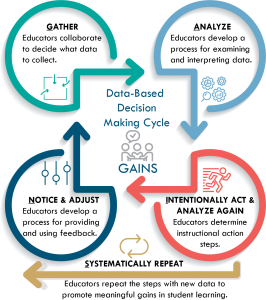
Activity: Select and print one or more of the DBDM cycles, below. Based on what you are able to infer about the Essential Functions and your interpretation of the labels on the DBDM cycles, match the steps on the DBDM cycles with the Essential Function that best fits, writing the Essential Function Number next to the appropriate step (i.e., EF1, EF2, EF3 or EF4). You can label more than one DBDM step with the same Essential Function. Hang on to your sheet(s) for an activity later in this PLM.


This lesson will use the Essential Functions and corresponding components of GAINS to help teams to understand how to implement DBDM in their districts and schools.


