

EF3: Educators Determine Instructional Action Steps
The third essential function, Educators Determine Instructional Action Steps is summarized by the third component of the GAINS acronym Intentionally act and analyze again and answers the question, “what can we do about the problem?”
Once the team has identified a possible cause of the problem they are trying to solve, they select action steps that are likely to address the problem. Action steps should be evidence-based, directly address the root cause of the problem, have contextual fit, and be within the capacity of those who will implement.
For example, say a novice teacher is writing a lot of office referrals. A brief survey of the students shows that they do not know the expected behaviors for different classroom procedures. Some evidence-based practices that the team can implement are to work with the teacher to: clarify procedures for common activities; directly teach these procedures to the students; provide students with opportunities to practice these behaviors to fluency; and provide positive specific feedback to students who engage in the behavioral expectations.
Once steps are selected they are put into an action plan format. An action plan format is a plan that is written in such a way that it makes it easier for teams to hold themselves accountable for implementing the plan. Action plans typically include the goal or outcome, action steps to achieve the goal or outcome, individuals responsible for making sure the action step is completed, and timelines for completing the action steps.
In order for a plan to work, it must be implemented. Furthermore, even when a plan is implemented, there may sometimes be a misalignment between the action steps and the cause of the problem, either because the team did not accurately identify the cause of the problem, or because the team selected a practice that did not address the cause. Therefore, the team selects and monitors results indicators (Peery, 2011). Results indicators are easily measured data points that teams can use to monitor progress of plan implementation and progress toward the desired outcome. Results indicators typically measure whether the adults are implementing the plan, and whether students are making adequate progress toward the goal. They are collected and reviewed frequently, so that teams can make timely mid-course corrections, as needed.
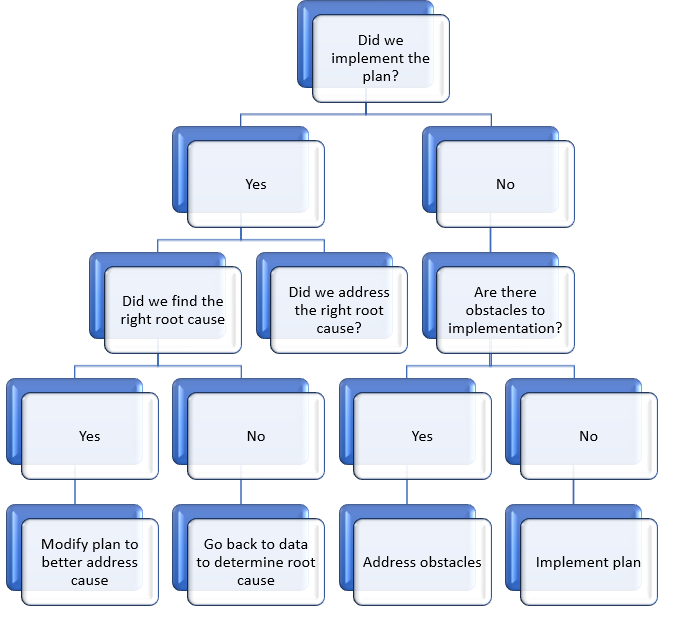
Teams schedule frequent monitoring meetings to review results indicators. If the plan is being implemented and students are making adequate progress, no change is indicated. However, if adequate progress is not being made toward the desired outcome, the following decision-making tree can be used to guide teams in how to respond:
- Are we making adequate progress?
- Yes: keep doing what we are doing.
- No: Did we implement the plan?
- Yes: Did we find the right root cause?
- Yes: Modify the plan to better address the root cause.
- No: Go back to data to identify the correct root cause.
- No: Are there obstacles to implementation?
- Yes: address the obstacles.
- No: Implement the plan.
- Yes: Did we find the right root cause?


