

“…team decisions will be more effective and efficient when they occur in the context of a formal problem-solving model with access to the right data, in the right format, at the right time.”
Newton, Horner, Algozzine, Todd & Algozzine, 2009
As educators, we make decisions constantly. We make decisions about what to teach, when to teach it, and how to teach it. We make decisions about what improvement goals to set and how to achieve them. We make decisions about how to respond when students behave a certain way and how to respond when students don’t behave at all! These decisions can be informed by intuition, an educated guess, or they can be informed by data.
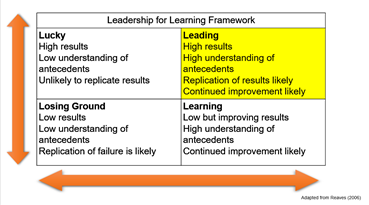
You may be familiar with this 4×4. It came out of the PLC literature (Reaves, 2006). This captures the idea behind data-based decision making. Schools that make decisions based on intuition or an educated guess tend to fall in the “Losing Ground” or “Lucky” quadrant. Either they are getting poor results and don’t know why or what to do about it, or they are getting good results, but they don’t know why and cannot replicate them. They may attribute student outcomes to things outside of their control. Teams that recognize the causal relationship between adult actions and student outcomes begin to move into the “Learning” and “Leading” quadrants. In the “Learning” quadrant, teams begin to use data to monitor both what the adults are doing and the impact these actions are having on students. This allows them to determine which activities are working, and which are not working. Results are improving, but are not yet where they want. Finally, teams that effectively use data to identify causal relationships, select evidence-based practices that are targeted to address needs identified by the data, and make midcourse corrections based on data, begin to see positive academic and behavioral outcomes for their students. Such schools are described as “Leading.”
Question: Is your team “Lucky,” “Losing,” “Learning,” or “Leading?” Why did you select that quadrant?
Teams that engage in DBDM focus on the relationship between what the adults do, and the impact that their actions have on students. When the adults act with intentionality to implement an evidence-based practice, they can collect data to help them monitor the extent to which they are implementing the practice (implementation data). They can also collect data on the impact that their actions are having on desired student outcomes. By monitoring the relationship between their efforts (implementation) and the impact these efforts have on students (outcomes), they are able to make timely mid-course corrections, and stay on course to achieve their goals. As educators engage in data-based discussions about how their activities impact student outcomes, they are able to share practices and strategies that have a proven track record, and abandon activities that have poor effects. Not only does this improve student outcomes, it also increases a sense of efficacy among educators.


